Rufo report details $1B+ in annual dues for California's top public-sector unions
Source: Fox News · All Fox News reports
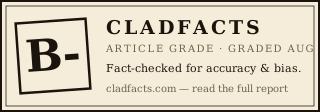
Why this grade: Core figures on union revenue ($1B+), membership (>1M), and staff (>1,500) match the authors' disclosure-based analysis; political spending ($29M) also aligns. Fails on context for California's overall condition and omits counter-evidence on union roles or other influences.
Why this lean: Segment relies on Rufo and frames unions exclusively as a one-party Democratic machine; uses loaded terms like 'third world disaster' and 'flushing it down the toilet' with no opposing perspectives or data on voter bases, policy outcomes, or corporate influence.
Embed this grade
Disagree with this grade or political lean?
Tell us why. Your note is reprocessed through the same grading logic; if the output is still off the report is removed, and if it holds up it stays.
Topics in this report
Summary
The Fox News segment features Christopher Rufo discussing his City Journal report on California's ten largest public-sector unions. It claims they collected over $1 billion in dues and fees in the year ending 2024 from more than one million members, employ over 1,500 staff including political organizers, and spent at least $29 million on lobbying and politics, creating a self-reinforcing cycle favoring Democrats. The host describes California as a 'third world disaster' due to bureaucracy, taxes, and special interests. Rufo explains the feedback loop of unions pushing higher taxes and spending to grow membership and dues. The report focuses on unions like the California Teachers Association and SEIU affiliates.
Editorial Assessment
The broadcast accurately conveys the report's primary data points drawn from union filings, but the framing presents the unions as the dominant explanation for Democratic control while ignoring broader factors such as voter demographics, cultural issues, and other organized interests. Language describing the state as a 'third world disaster' lacks supporting metrics in the segment and contrasts with California's continued economic output and population size. Viewers miss context on how dues are collected (voluntary post-Janus in many cases) and the unions' claimed benefits to members, as well as data on total political spending by all groups. The one-sided sourcing and absence of counter-analysis tilt the presentation toward reinforcing a partisan narrative of inevitable decline driven by this mechanism.
Key Moments
Top 10 public-sector unions collected more than $1 billion in dues and fees in the year ending 2024
Directly matches Rufo/Schrupp City Journal analysis of disclosure forms; corroborated in reprints.
Unions employ more than 1,500 full-time staff including political organizers and activists
Report states the ten unions list more than 1,500 employees and officers who administer, organize, and advance political interests.
California has become a 'third world disaster' due to bureaucracy, taxes, and union power
Opinionated characterization; segment provides no comparative economic or governance metrics.
Unions create a self-reinforcing machine maintaining one-party Democratic control
Report documents the dues-to-politics pipeline; omits other voter coalitions and historical Democratic advantages in the state.
Notable Concerns
- Partisan framing with no counter-sources or alternative explanations for Democratic strength
- Hyperbolic state description unsupported by data in the segment