Welch Blasts Trump's Canada Tariffs, Introduces BAD DEAL Act for Refunds
Source: CBS News · All CBS News reports
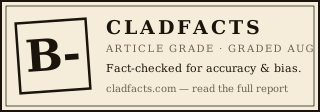
Why this grade: Graded B-: Most empirical claims (tourism decline, trade deficit existence, constitutional tariff authority, Smoot-Hawley precedent) verified by official data and history; however, 50% tourism figure is approximate and context on retaliatory tariffs from both sides plus legal basis for Trump's Section 338 use is missing.
Why this lean: Interview features only a Democratic senator offering unchallenged criticism of Trump; frames tariffs solely as harmful insults and taxes with no administration official, Republican voice, or counter on trade imbalances and leverage.
Embed this grade
Disagree with this grade or political lean?
Tell us why. Your note is reprocessed through the same grading logic; if the output is still off the report is removed, and if it holds up it stays.
Topics in this report
Summary
CBS News interviewed Sen. Pete Welch (D-VT) on the impacts of President Trump's tariffs on Canada, which escalated into a trade war with 50% duties on select goods after failed negotiations. Welch described severe harm to Vermont's economy, including a roughly 50% drop in Canadian tourism due to rhetoric such as renaming Lake Ontario "Lake America" and calling Canada the 51st state. He highlighted higher fertilizer costs for farmers, uncertainty for manufacturers, and rising electricity and heating prices. Welch discussed his bill with Sen. Gillibrand, the BAD DEAL Act, which would declare the tariffs illegal, repeal the underlying authority in the 1930 Tariff Act, and provide refunds to businesses that paid them. He noted seeking Republican co-sponsors and argued trade deficits do not mean the US is "losing money."
Editorial Assessment
The segment accurately conveys Welch's perspective and Vermont-specific effects, backed by reports of sharp Canadian tourism declines (25-47% drops in visits and spending in 2025-2026 data). Claims about 34 states having Canada as top partner and constitutional questions over presidential tariffs are largely correct. Viewers miss critical context: the US ran a documented $27-48 billion goods trade deficit with Canada in 2025 (narrowing from prior years), driven heavily by oil imports beneficial to US refineries; Canada retaliated with its own tariffs; and Trump invoked Section 338 of the 1930 Tariff Act to address alleged discriminatory practices. The one-sided format and loaded language ("insults," "bullying," "trade war is really harmful") skew perception toward viewing the policy as purely destructive without discussing intended leverage on issues like dairy access or autos. Overall, a partisan interview rather than comprehensive reporting.
Key Moments
Vermont lost about 50% of its tourism from Canadians due to the trade war and presidential insults
Consistent with multiple reports documenting 25-47% declines in Canadian visits, border crossings, and spending in Vermont in 2025-2026 amid boycott sentiment.
Trump's tariffs go back to Smoot-Hawley, which contributed to the Great Depression; president has no authority as Constitution gives only Congress right to raise taxes
Smoot-Hawley raised tariffs broadly in 1930 and worsened trade; modern presidents have used delegated authority like Section 338 of that same act, which the BAD DEAL Act seeks to repeal.
The president is mistaken in confusing trade deficit with losing money; tariffs raise prices for consumers, businesses, and farmers
Economists broadly agree trade deficits are not equivalent to losses (US imported $454B vs exported $426B in 2025 per USAFacts); tariffs function as taxes typically passed on to importers/consumers.
Introducing the Bad Deal Act with Sen. Gillibrand to declare tariffs illegal and guarantee refunds to businesses that paid them
The bill (full name Banning Antiquated Duties and Delivering Equitable American Levies Act) introduced by Gillibrand and cosponsored by Welch repeals Section 338 and mandates refunds.
Notable Concerns
- Exclusive platform for one Democratic critic without rebuttal or administration viewpoint
- Omission of US trade deficit data and rationale for tariffs despite Welch addressing the topic
- Approximate 50% tourism figure aligns with directional trends but lacks precise sourcing in the clip
Sources Consulted
- What is the value of US trade with Canada?
- Canada | United States Trade Representative
- Vermont Was Canada's Second Cottage Country. Not Anymore.
- Trump’s 50% Tariffs on Canada: What to Know, and What’s Next
- Fact-checking Trump's August 2026 claims on US-Canada trade
- Gillibrand Demands An End To Trump's Tariff Chaos...
- Welch Urges Trump to Drop 50% Tariffs on Canada and End the Trade War