Burchett questions Friedman on Saudi entry into Abraham Accords amid Iran threats
Source: Forbes Breaking News · All Forbes Breaking News reports
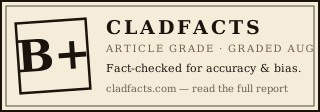
Why this grade: Graded B+: claims on Accords structure, Saudi security priorities, US predictability needs, and specific cooperation examples (CENTCOM cell, Iron Dome to UAE) are well-supported by primary records and reporting; minor limitation is heavy reliance on one expert's analysis without counter-views.
Why this lean: Positive framing of Abraham Accords and Israeli security stance; criticism of US polarization includes both extremes but stresses need for reliable pro-Israel policy; guests are Republican congressman and Trump-era ambassador.
Embed this grade
Disagree with this grade or political lean?
Tell us why. Your note is reprocessed through the same grading logic; if the output is still off the report is removed, and if it holds up it stays.
Topics in this report
Summary
Forbes Breaking News clip shows Rep. Tim Burchett (R-TN) interviewing former US Ambassador to Israel David Friedman. They discuss what Saudi Arabia would require to join the Abraham Accords, Saudi national security concerns versus Iran, the private versus public nature of Arab diplomacy, and lessons from the first five years of the Accords. Friedman describes the deals as US-centered triangles focused on practical security interests rather than ideology or economics. Burchett raises the impact of the Iran conflict on Accords partners. The segment ends with Friedman's call for bipartisan, predictable US policy toward Israel.
Editorial Assessment
The discussion accurately captures the triangular structure of the Accords and the role of national security incentives, corroborated by the 2020 agreements and subsequent developments. Friedman's points on Saudi priorities and post-October 2023 Israeli caution align with Riyadh's repeated statements tying normalization to Palestinian progress and Israel's hardened position. Verified elements include the January 2026 CENTCOM Middle East air defense cell and Israel's Iron Dome deployment to the UAE during 2026 Iran-related fighting. Viewers miss broader context on stalled Saudi talks due to the Palestinian issue and recent Gulf hedging strategies. The exchange is substantive but one-sided, presenting normalization as broadly beneficial without exploring risks or Arab public opinion shifts.
Key Moments
Abraham Accords form US-Israel-Arab triangles with each party pursuing goals for different reasons
Matches the structure of the 2020 agreements mediated by the US.
Saudi Arabia's primary concern is national security in a tough neighborhood facing Iran
Consistent with Saudi statements and regional analyses.
CENTCOM announced a Middle East air defense cell; Israel deployed Iron Dome to defend UAE
CENTCOM cell opened January 2026 in Qatar; Iron Dome deployment confirmed during 2026 Iran conflict.
Israel will not create a Palestinian state just to secure Saudi normalization post-October 7
Reflects Israeli position but omits ongoing international pressure and Saudi insistence on Palestinian track.