Panel assesses Trump foreign policy amid Venezuela Maduro capture and ally tensions
Embed this grade
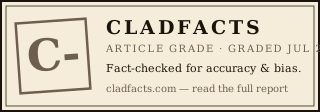
Why this grade: Venezuela capture and Greenland/Canada/Cuba threats verified by reports, but core Iran war narrative and 'cakewalk' framing lack corroboration and rely on anonymous or interpretive sourcing.
Why this lean: Solely critical framing of Trump actions as chaotic overreach; guests from establishment outlets emphasize ally insults and quagmire risks without counter perspectives.
Disagree with this grade or political lean?
Tell us why. Your note is reprocessed through the same grading logic; if the output is still off the report is removed, and if it holds up it stays.
Topics in this report
Summary
Segment opens with breaking news on US strike capturing Maduro in Venezuela and shifts to discussion of US-Israel operations against Iran. Panelists debate whether there are signs Iran is ready to stop fighting. Guests include Richard Heis of Council on Foreign Relations, Kim Gatas of Financial Times, and David Ignatius of Washington Post. They analyze Trump's second-term foreign policy as aggressive unilateralism with anti-ally bias, acquisitive aims in Venezuela and elsewhere, and a miscalculation on Iran. Discussion covers regional impacts in Lebanon and Gulf states, Iranian internal divisions, and risks of deeper US involvement.
Editorial Assessment
Accurate on the January 2026 Venezuela operation and documented Trump statements on Greenland, Canada, and Cuba. Iran-related claims of major ongoing combat, easy initial expectations, and current stalemate receive no independent verification and appear to drive the narrative. Framing emphasizes overreach and legacy-seeking without balancing strategic rationales or successes cited by administration. Viewers miss primary data on Iran casualties, timelines, or official statements confirming the scale of operations described. Reliance on interpretive analysis from aligned outlets creates one-sided perspective on events.
Key Moments
US carried out large-scale strike capturing Maduro and wife in Venezuela
Confirmed by multiple outlets reporting Jan 3 2026 operation; Maduro flown to US for prosecution.
Trump got Iran wrong, expected easy cakewalk like Venezuela
No corroborating reports of major US combat operations or initial expectations in Iran; framing interpretive.
Trump threatening or invading Greenland, Canada, Cuba, and Iran
Threats to Greenland/Canada/Cuba documented; 'invading Iran' lacks evidence of ground invasion.
Iran regime support at 20% or less with mass protests
Panel cites January protests; no recent polls or data provided to confirm current figures.
Notable Concerns
- Unverified claims of active large-scale US-Israel war in Iran
- Selective emphasis on negatives without counter-evidence on policy outcomes
Sources Consulted
- Trump: US captures Venezuela's Maduro after strikes on country
- U.S. strikes in Venezuela trigger regional and global alarm
- Trump on return trip to Washington predicts demise of Cuba, warns Colombia, threatens Greenland
- Trump's latest Western Hemisphere fixation: Canada
- What we know about a U.S. strike that captured Venezuela's Maduro