House panel reviews 9/11 lessons on AI, cyber and state actor threats
Source: moneycontrol · All moneycontrol reports
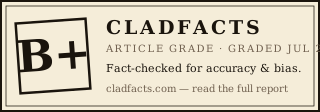
Why this grade: Graded B+: testimony from credible experts was mostly accurate and grounded in documented threats, but partisan exchanges introduced selective framing on elections and specific policy critiques lacked full sourcing.
Why this lean: Framing emphasized China as primary threat and need for stronger US posture; minor rightward tilt from witness selection and critiques of prior administration policies on intelligence sharing.
Embed this grade
Disagree with this grade or political lean?
Tell us why. Your note is reprocessed through the same grading logic; if the output is still off the report is removed, and if it holds up it stays.
Topics in this report
Summary
The hearing was the second public session of a bipartisan House task force reviewing the 9/11 Commission report. Members and witnesses discussed how threats have evolved beyond terrorism to include great-power competition, AI-enabled cyber and influence operations, drones, and gray-zone activities by China, Russia, Iran, and North Korea. Experts testified that the US homeland is no longer a sanctuary and that intelligence and law enforcement structures must adapt faster.
Editorial Assessment
The broadcast captured substantive expert testimony on real, documented threats with specific examples such as Chinese espionage cases and cyber campaigns. Partisan exchanges on election integrity and Trump administration actions introduced some selective emphasis and missing context on agency staffing or past reforms. Viewers missed broader data on implementation of 9/11 recommendations and quantitative metrics on current IC capabilities. Overall, the segment provided useful context on emerging risks but would benefit from more primary sourcing on AI capability claims.
Key Moments
China presents the most serious state-based threat including in the homeland, with extensive MSS and MPS activity
Consistent with public reporting on Chinese espionage convictions and operations.
AI has enabled Chinese state-sponsored groups to run largely automated cyber espionage campaigns
Matches Anthropic and Google public reports on model misuse cited in testimony.
US fusion centers and JTTFs are not equipped to handle state-based actor threats
Reflects witness view; post-9/11 structures were primarily CT-focused, but expansions have occurred.
Vault Typhoon represents operational preparation of the battlefield by China
Aligned with CISA and NSA public attributions of the campaign.
Notable Concerns
- Partisan exchanges on election claims introduced selective framing without full counter-evidence