Dexter details Cuba fuel crisis after July 2026 delegation, urges end to embargo
Embed this grade
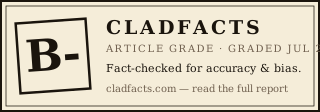
Why this grade: Graded B-: core claims on Trump administration's 2025-2026 sanctions tightening, effective fuel blockade, and resulting blackouts match reporting; interpretive framing of intent and some healthcare details lack balance or sourcing.
Why this lean: Strongly critical framing of US policy as 'cruel' and 'intentional suffocation,' emphasis on Cuban people's suffering and calls for engagement while omitting Cuban government responsibility or sanctions context.
Disagree with this grade or political lean?
Tell us why. Your note is reprocessed through the same grading logic; if the output is still off the report is removed, and if it holds up it stays.
Topics in this report
Summary
Rep. Maxine Dexter (D-OR) addresses the House after a July 2026 congressional delegation visit to Cuba. She describes the effects of US policy on fuel imports, electricity, daily life, and healthcare access. The speech references Obama-era normalization reversed in 2017, Trump's January 2025 actions, a 2026 executive order targeting oil suppliers, hospital conditions observed in Havana, Cuba's free healthcare system, and support for Rep. McGovern's legislation to lift the embargo while opposing military action.
Editorial Assessment
The broadcast accurately captures the documented 2026 energy crisis triggered by tightened US sanctions and loss of Venezuelan/Mexican oil supplies, including blackouts and medical supply issues. Missing context includes Cuba's pre-existing economic problems, reliance on subsidized Venezuelan oil, and the sanctions' stated aims regarding regime behavior and alliances. Equipment import barriers are longstanding but worsened by the crisis; claims of intentional harm to the population reflect one-sided framing. Viewer misses counter-evidence on Cuban governance failures and full policy rationale. Overall presentation is advocacy-oriented rather than balanced reporting.
Key Moments
Trump cut off ability for any fuel to enter Cuba immediately after January 2025 return to office
Actions escalated in 2025-2026; key January 2026 EO imposed tariffs on oil suppliers after Maduro ouster halted Venezuelan shipments
Hospitals nearly empty, CT scanners broken, long surgery waits due to insufficient supplies and import restrictions
Delegation observations align with reports of crisis impacts on healthcare and equipment
Cuba's public health system is the envy of the world with free care for all
Cuba maintains universal access claims but faces chronic shortages, quality issues, and doctor export programs criticized elsewhere
Calls to co-sponsor McGovern's legislation ending the trade embargo
McGovern introduced H.R. 7521 in February 2026 to repeal embargo provisions
Notable Concerns
- One-sided sourcing from delegation visit and Cuban officials; limited acknowledgment of Cuban regime actions or sanctions' national security basis
Sources Consulted
- U.S. Policy Toward Cuba: Recent Developments and ...
- The Crisis in Cuba, Explained
- Reps. Dexter, Pocan, Leger Fernandez, and Ramirez Return From Cuba Fact-Finding Mission
- McGovern Introduces New Bill To Repeal U.S. Embargo Against Cuba
- From blackouts to food shortages: How US blockade is crippling life in Cuba