Hoffman says IRGC holds absolute control amid Iran-US strikes and Hormuz tensions
Embed this grade
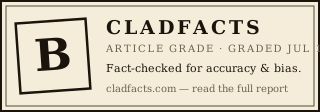
Why this grade: Graded B: Core assessments on IRGC dominance, Hormuz disruptions, and regime priorities align with contemporaneous reporting; several strategic claims lack sourcing or overstate certainty on control and protests.
Why this lean: Strong right lean via exclusive reliance on former US officials and Trump administration framing, emphasis on military escalation options, and portrayal of Iran as irredeemable aggressor.
Disagree with this grade or political lean?
Tell us why. Your note is reprocessed through the same grading logic; if the output is still off the report is removed, and if it holds up it stays.
Topics in this report
Summary
Fox News segment features former CIA station chief Dan Hoffman analyzing the breakdown of a cease-fire, Iranian strikes on US bases including one killing troops in Jordan, and the path forward for the Trump administration. Hoffman discusses IRGC dominance, Iran's goals regarding the Strait of Hormuz and regional influence, a war of attrition, and options like resuming strikes on leadership or infrastructure. The discussion references prior comments from Mike Pompeo, highlights Iran's economic woes versus regime resilience, and questions whether negotiations or force will induce behavioral change. Sourcing is limited to Hoffman's expertise and anonymous intelligence references; no opposing Iranian perspectives or data graphics appear.
Editorial Assessment
The segment accurately captures the 2026 conflict backdrop of Hormuz tensions, strikes, and cease-fire collapse as reported across outlets, with Hoffman correctly noting IRGC economic entrenchment and Iran's sanctions-hit economy. Viewer perception may be skewed by the absence of context on Iranian domestic constraints, US/Israeli actions that preceded escalations, or diplomatic efforts still underway. Claims of 'absolute control' and zero protests reflect plausible wartime conditions but rest on expert assertion rather than cited evidence. Overall, it functions as policy advocacy more than neutral analysis, omitting counterpoints on negotiation viability or economic pain thresholds.
Key Moments
IRGC is in absolute control of Iran with no protesters on the streets
IRGC holds significant power and economy influence per multiple analyses; wartime suppression of protests is plausible but unverified in segment.
Iran attempting to close Strait of Hormuz to disrupt global economy
Matches July 2026 reports of Iranian declarations, ship attacks, and slowed traffic amid US-Iran clashes.
Iran's hardline IRGC regime seeks to eliminate US influence in the Middle East
Consistent with long-standing IRGC doctrine and 2026 conflict dynamics reported by Reuters and others.
Trump administration must examine all options including decapitation strikes to induce negotiations
Reflects hawkish analysis; segment omits ongoing talks and prior US/Israeli strikes that frame the escalation.
Notable Concerns
- Relies solely on one US intelligence veteran without balancing views or primary documents
- Hyperbolic phrasing on regime control and pain tolerance presented as fact
Sources Consulted
- The IRGC is in ‘absolute control’ of Iran, former CIA station chief says
- Trump says US will become 'guardian' of Strait of Hormuz and collect tolls
- Iran Conflict and the Strait of Hormuz: Impacts on Oil, Gas ...
- Fed-up Trump threatens to 'blow the s–t' out of Iran
- With Iran deal, Trump told ships to 'start your engines.' That’s not happening yet
- Daniel Hoffman | Intelligence & Security Advisor at BGR