Jayapal cites 1960 memo to argue US Cuba embargo amounts to collective punishment
Embed this grade
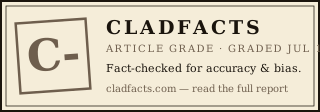
Why this grade: Accurate on Geneva Article 33 text, 1962 embargo date, and Mallory memo language, but applies Geneva outside its occupied-territory scope, attributes all suffering to embargo while omitting regime mismanagement and recent data disputes, and offers no sourcing for hospital anecdotes or visit.
Why this lean: Frames embargo as sole driver of Cuban hardship, highlights regime victims selectively, and advocates unilateral US concessions without balancing Cuban government repression or policy failures.
Disagree with this grade or political lean?
Tell us why. Your note is reprocessed through the same grading logic; if the output is still off the report is removed, and if it holds up it stays.
Topics in this report
Summary
The video shows Rep. Pramila Jayapal questioning a witness named Mr. Orr during a hearing or interview. She reads Article 33 of the Fourth Geneva Convention, references a 1960 classified State Department memo on embargo goals, describes worsening conditions in Cuba including health care failures, and argues the US embargo constitutes collective punishment that has failed for 60+ years. She calls for lifting the embargo and pursuing negotiations instead.
Editorial Assessment
The core historical citations hold up, but the piece lacks balance on causation of Cuba's crises, applicability of international humanitarian law to peacetime sanctions, and the Cuban government's documented role in repression and economic mismanagement. Recent 2025-2026 reports note rising infant mortality amid tightened US measures and energy shortages, yet independent analyses also point to internal factors. Viewer misses counter-evidence on one-party elections, political prisoners, and alternative policy rationales. Emotional hospital descriptions are unsourced and unverified here.
Key Moments
Article 33 Fourth Geneva Convention prohibits punishing people for offenses they did not commit, applying to the Cuba embargo
Quote accurate per ICRC; Article applies to protected persons in armed conflict/occupation, not standard interstate economic sanctions.
1960 classified State Department memo sought to bring about hunger, desperation, and overthrow of Cuban government via sanctions
Lester D. Mallory memo, April 6, 1960, declassified and widely cited in primary archives.
Cuba has held no fully democratic elections and continues detaining political prisoners since 1962 embargo
Cuba remains a one-party Communist state per Freedom House, V-Dem, and election records; political prisoners documented by rights groups.
Infant mortality up, no food/water/medical supplies due to embargo; recent visit showed cell-phone-light surgeries
Infant mortality rose per 2026 CEPR report amid sanctions, but baseline was low; regime and external factors cited in other analyses; anecdotes unsourced.
Notable Concerns
- Geneva Convention applicability overstated without legal context
- Causation of Cuban conditions attributed solely to embargo
- Anecdotal claims on medical care lack sourcing or verification
Sources Consulted
- Memorandum From the Deputy Assistant Secretary of State for Inter-American Affairs (Mallory) to the Assistant Secretary of State for Inter-American Affairs (Rubottom)
- State Department, Memorandum, “The Decline and Fall of Castro,” Secret, April 6, 1960
- Geneva Convention (IV) on Civilians, 1949 - Article 33
- Cuba Sanctions - United States Department of State
- US Sanctions and the Sharp Rise in Infant Mortality in Cuba - CEPR
- Cuba: Freedom in the World 2024 Country Report - Freedom House