Legal analysis of proposed US tolls on Strait of Hormuz shipping
Embed this grade
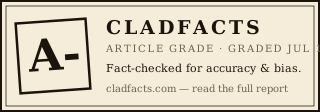
Why this grade: Graded A-: core legal claims on transit passage and IMO position are well-supported by expert analysis and primary statements; minor issues include limited discussion of customary law nuances and evolving US policy details
Why this lean: Al Jazeera frames the segment around skepticism of US authority while featuring a respected independent expert; emphasis on equal application of law to US and Iran without one-sided sourcing
Disagree with this grade or political lean?
Tell us why. Your note is reprocessed through the same grading logic; if the output is still off the report is removed, and if it holds up it stays.
Topics in this report
Summary
The segment covers President Trump's announcement of a 20% toll on cargo transiting the Strait of Hormuz and the IMO's opposition to mandatory fees in international straits. It features an interview with Marc Weller of Chatham House discussing whether the US has any greater right than Iran to impose charges. Weller explains that transit passage principles under UNCLOS and customary law prohibit impeding or charging for passage through international straits, noting neither the US nor Iran has ratified the convention. The discussion references recent attacks, potential walk-backs, and possibilities of voluntary contributions.
Editorial Assessment
The broadcast accurately conveys the prevailing expert and institutional view that mandatory tolls lack legal basis under the regime for international straits. Viewers receive clear context on the equal application of law but may miss deeper exploration of enforcement mechanisms, historical precedents for safety fees, or how customary law binds non-parties. Framing highlights US limitations without overstating Iranian rights. Sourcing relies on a named academic expert and the IMO statement rather than anonymous officials.
Key Moments
IMO states no legal basis for mandatory tolls in international straits
Directly matches IMO statement reported across multiple outlets confirming opposition to fees for transit passage
Neither US nor Iran entitled to charge fees or impede transit passage under international law
Consistent with Chatham House analysis by Weller and legal commentary on UNCLOS Part III transit passage rules
US has no right to appoint itself guardian and charge 20% for protection
Reflects expert assessment; aligns with reports of Trump's announcements and subsequent clarifications or walk-backs
Voluntary contributions for security could differ from mandatory tolls
Expert distinguishes the two but broadcast provides limited detail on precedents or feasibility