Rep. Joyce Urges CHARM and BRACE Acts to Recover Critical Minerals from US Waste
Embed this grade
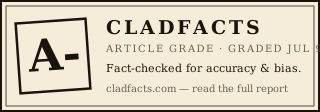
Why this grade: Testimony accurately describes pending CHARM and BRACE Acts and references the Idaho National Laboratory tailings report; China dominance claims are broadly supported by industry data though unsourced in the clip.
Why this lean: Emphasizes national security and reducing reliance on China while advancing bipartisan legislation; guest and framing align with Republican priorities on domestic production.
Disagree with this grade or political lean?
Tell us why. Your note is reprocessed through the same grading logic; if the output is still off the report is removed, and if it holds up it stays.
Topics in this report
Summary
The Forbes clip shows Rep. John Joyce (R-PA) during a June 2026 House Energy and Commerce Environment Subcommittee hearing titled 'Trash to Treasure.' He questions witnesses on two draft bills aimed at recovering critical minerals from industrial waste and spent batteries rather than exporting them for processing. Witnesses from DISA and a battery recycler discuss regulatory barriers, uranium tailings, and the need for EPA coordination. The segment covers the CHARM Act's national recovery strategy and the BRACE Act's permitting reforms for lithium-ion batteries.
Editorial Assessment
The clip presents straightforward congressional testimony without distortion. Claims about China's supply-chain dominance and long mine-development timelines match longstanding US government and industry assessments. The referenced Idaho National Laboratory report on tailings recovery exists and supports the core argument. Viewers miss the bills' current status—they advanced out of subcommittee in late June—and the bipartisan elements noted in committee releases. Framing prioritizes economic and security imperatives over environmental trade-offs in recovery processes.
Key Moments
US imports 97% of its uranium, with abundant untapped resources in legacy tailings
INL 2025-2026 tailings report and standard DOE data confirm high import reliance and tailings potential.
CHARM Act directs EPA to develop a critical national mineral recovery strategy
Bill text and committee announcements confirm the EPA coordination requirement within two years.
Foreign processors face fewer regulations than US domestic operators, creating an uneven playing field
Witness testimony reflects industry views; US RCRA and environmental rules are stricter, but enforcement and foreign standards vary.
New mines take 10-15 years while waste recovery can be faster
Standard permitting timelines cited widely; tailings recovery avoids new permitting delays.
Sources Consulted
- Chairmen Guthrie and Palmer Announce Legislative Hearing to Examine Domestic Critical Mineral Recovery
- Federal critical minerals bills target battery recycling, EPA strategies
- Critical-Minerals Recovery from Mine Tailings: A Technical Review and Strategic Assessment
- House Advances Three Bills to Expand Critical Mineral Recycling
- Environment Subcommittee Holds Hearing to Examine Legislation Supporting Domestic Critical Mineral Recovery and Recycling