Takano questions witnesses on ACA, Medicaid coverage losses in committee hearing
Embed this grade
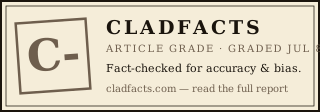
Why this grade: Graded C-: core economic concerns about uncompensated care are documented in health policy literature, but load-bearing claims of 5-8 million recent ACA losses and a precise 15 million CBO projection for HR1 lack supporting primary sources or verification.
Why this lean: Title and narration frame the exchange as exposing 'GOP cuts' and emphasize one side's view of coverage as public investment while portraying market-oriented responses as evasive; relies primarily on Democratic congressman's questions.
Disagree with this grade or political lean?
Tell us why. Your note is reprocessed through the same grading logic; if the output is still off the report is removed, and if it holds up it stays.
Topics in this report
Summary
The segment shows Rep. Mark Takano questioning witnesses during a House committee hearing on health care. He references recent ACA coverage losses and asks about projected impacts of ACA tax credit expirations and Medicaid changes under HR1, citing a 15 million total loss figure from CBO. Witnesses include Mr. Woodhouse, Dr. Savage, and Mr. Newman, who respond on uncompensated care, premiums, and market alternatives like direct contracting. The narration contrasts views of coverage as a stabilizing public investment versus market competition. The broadcast highlights Takano's frustration with hesitant or negative answers on system-wide cost pressures.
Editorial Assessment
The video accurately captures standard arguments that coverage losses can increase uncompensated care and shift costs to insured premiums, a dynamic discussed in health economics for decades. However, it presents the 15 million figure and recent multi-million losses as settled without citing the underlying CBO report or enrollment data, and dismisses contrary witness views without engaging studies on premium trends or coverage effects post-ACA. Rural provider and direct contracting discussion receives limited context on existing market dynamics or hospital finances. Viewers miss independent verification of the specific HR1 provisions, current uninsured rates, or counter-data on whether coverage expansions fully offset cost-shifting. The partisan title and selective emphasis on one framing tilt perception toward alarm over policy trade-offs.
Key Moments
5 million Americans kicked off ACA coverage in the past year; witness claims 8 million
No matching official enrollment or termination data located for recent period; figures presented as dialogue without external corroboration.
CBO estimated 15 million would lose coverage under HR1 from ACA tax credits and Medicaid cuts
No CBO report or HR1 legislative text found matching this aggregate projection or timeline.
Losing coverage for millions will increase uncompensated care and drive up premiums for others
Uncompensated care cost-shifting is a documented phenomenon, but magnitude depends on specific policy details, safety-net funding, and utilization patterns not addressed.
Direct contracting and market approaches can lower costs even in rural or single-provider areas
Witness arguments reference provider burnout and cash flow but omit data on rural hospital closures or existing direct primary care outcomes.
Notable Concerns
- Specific numeric claims on coverage losses (5M, 8M, 15M) presented without primary sourcing or verification
- Hearing date, full bill text, and witness affiliations not disclosed