Panetta Questions Tax Guidance for NIL Athletes in Congressional Hearing
Embed this grade
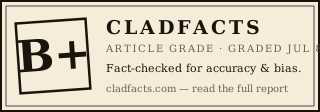
Why this grade: Graded B+: All major claims on taxability of NIL income, lack of specific regulations/precedents, IRS TAS general guidance, and need for education align with IRS publications and recent testimony; minor omission of self-employment tax rate details and post-2025 House settlement context.
Why this lean: Slight positive lean from emphasis on modernizing tax code for large NIL revenues and praising university/private efforts; Democratic Rep. Panetta's questions focus on practical implementation rather than partisan critique.
Disagree with this grade or political lean?
Tell us why. Your note is reprocessed through the same grading logic; if the output is still off the report is removed, and if it holds up it stays.
Topics in this report
Summary
The Forbes Breaking News clip covers a congressional hearing segment where Rep. Jimmy Panetta (D-CA) questions witnesses about tax compliance challenges for college athletes earning NIL revenue. Witnesses, including tax consultant Thad Madden and an ESPN contributor/athlete family office advisor (likely Mr. Ochoa), discuss the complexity of tax obligations amid rising NIL and revenue-sharing payments following the 2025 House v. NCAA settlement. Panetta stresses the need for clear, modernized tax rules and asks who should provide guidance—universities, collectives, agents, or others—and whether conflicts of interest exist. Madden notes his firm's contracts with ~40 schools for payment processing, financial literacy, and tax advice, highlighting variability across universities. The advisor recommends independent, non-publicly traded entities to avoid conflicts with shareholder incentives.
Editorial Assessment
The segment accurately reflects the current state of NIL taxation: income is taxable as self-employment for most independent contractor arrangements, requiring quarterly estimates, Schedule C reporting, and self-employment taxes, with IRS TAS providing only generalized resources for self-employed individuals rather than NIL-specific rules. Claims about the novelty of NIL (no dedicated regulations or tax court precedents) hold up as of mid-2026. Viewers might miss broader context, including the 2025 House settlement enabling up to $20.5 million in annual revenue sharing per school and IRS memos limiting tax-exempt status for many collectives. The discussion usefully highlights real conflicts—universities balancing athlete interests with their own, and public financial firms prioritizing shareholders—but overstates the vacuum of guidance, as IRS has issued memos and athletes can access standard self-employment resources. Overall quality is strong for a short clip from a hearing, with named witnesses and practical focus, though it could benefit from more data on average NIL earnings or compliance rates.
Key Moments
NIL revenue is flowing in ridiculous amounts to student athletes, creating complicated tax obligations
Consistent with post-2025 House settlement allowing ~$20.5M revenue sharing per Power conference school; IRS confirms NIL income taxable.
Congress should mandate or authorize financial/tax education for young taxpayer athletes
Witnesses and experts widely recommend it; 49% of athletes report needing such resources per industry surveys, but no current federal mandate exists.
Universities are best positioned to implement authorized tax and financial education for athletes
Madden testified his firm contracts with 40 schools for exactly this; athletic directors and reports endorse university-led programs.
Publicly traded financial institutions have conflicts of interest and should not provide athlete guidance
Witness accurately contrasts shareholder-value incentives with athlete-focused private family offices; IRS warns of conflicts with collective-affiliated preparers.
IRS Taxpayer Advocate Service has issued advice for NIL athletes but it is general self-employed guidance with no specific regulations or precedents
TAS NIL page (updated through 2023-2026) directs to standard Pubs 334/525 and self-employment rules; IRS memos address collectives but no NIL-specific regs as of 2026.
Notable Concerns
- Limited discussion of self-employment tax burden (15.3%) or quarterly estimated payment requirements
- Omission of 2025 House settlement's revenue-sharing changes increasing tax complexity
Sources Consulted
- Name Image Likeness - Taxpayer Advocate Service
- Name, Image and Likeness (NIL) Income - IRS
- College Athlete Compensation: Impacts of the House Settlement
- NIL Tax Guide for College Athletes
- Testimony of Thaddeus J. Madden, Enrolled Agent
- Enhancing Financial Literacy Among College Athletes
- IRS Chief Counsel Memo AM 2023-004 on NIL Collectives