Lee Questions Witnesses on Hatch-Waxman Balance of Drug Innovation and Access
Source: Forbes Breaking News · All Forbes Breaking News reports
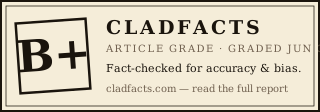
Why this grade: Mostly accurate framing of Hatch-Waxman success and patent thicket concerns; key statistics on exclusivity, biosimilar costs, and international delays align with studies but lack broader recent reform context.
Why this lean: Neutral congressional hearing coverage presenting both innovator and generic perspectives without loaded language or selective emphasis.
Embed this grade
Disagree with this grade or political lean?
Tell us why. Your note is reprocessed through the same grading logic; if the output is still off the report is removed, and if it holds up it stays.
Topics in this report
Summary
The clip shows Rep. Laurel Lee opening a House hearing questioning witnesses on the Hatch-Waxman Act's role in balancing pharmaceutical innovation with patient access to affordable generics and biosimilars. She asks about successful elements of the 1984 law and challenges like patent thickets. Witnesses include a representative from an innovator perspective and one from a biosimilar/generic manufacturer, discussing litigation frameworks, development timelines, and regulatory certainty. The segment ends as time expires.
Editorial Assessment
The broadcast accurately captures a standard congressional exchange on a well-studied policy area. Claims about Hatch-Waxman's historical impact, average exclusivity periods of 12-14 years, and biosimilar development costs of roughly 8 years and $100 million are supported by multiple analyses. Patent thicket issues and resulting US delays versus Europe are documented in peer-reviewed work. Viewers miss discussion of ongoing legislative proposals or quantitative data on recent generic entry trends. Framing remains neutral, highlighting shared goals rather than partisan conflict.
Key Moments
Hatch-Waxman created balance between patent rights and generic pathways, proving effective for decades.
Confirmed by FDA and PhRMA analyses showing generic share rising from 19% to over 90% of prescriptions.
Patent thickets via continuation patents have increased in last 10 years, delaying biosimilar entry versus other countries.
Multiple studies document US assertion of far more patents per product, with examples like Humira showing multi-year delays.
Biosimilar development takes 8 years and costs around $100 million.
Standard industry figures cited in economics literature range from 7-8 years and $100-250 million.
Drug exclusivity periods have remained steady at 12-14 years despite thickets.
Studies including Commonwealth Fund and JAMA Internal Medicine report median/average market exclusivity around 12-14.5 years.