Fox Business Panel Cites Resilience in Consumer Spending and Falling Inflation Expectations
Embed this grade
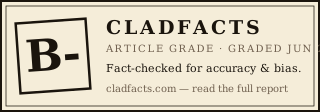
Why this grade: Graded B-: core data points like 0.7% nominal PCE rise and 5-year breakeven near 2.2% verified by BEA and FRED; durable goods and mortgage trends received selective or incomplete context, with optimistic policy framing
Why this lean: Emphasized positive effects of tax cuts, resilience under Trump policies, and Bessent's economic security agenda while downplaying recent durable goods decline and elevated PCE inflation
Disagree with this grade or political lean?
Tell us why. Your note is reprocessed through the same grading logic; if the output is still off the report is removed, and if it holds up it stays.
Topics in this report
Summary
Fox Business segment featured Larry Kudlow, Steve Moore, and John Carney discussing recent economic data showing consumer resilience after an oil shock, declining inflation expectations, strong business investment, and Treasury Secretary Scott Bessent's remarks on economic statecraft. They highlighted falling breakeven rates, energy prices, and the role of tax cuts in supporting growth. The panel tied national security to domestic industrial strength in semiconductors, AI, and other sectors, referencing Reagan-era principles and opposing tax increases. Bessent speech audio was played emphasizing building key industries at home.
Editorial Assessment
Claims on May PCE spending (+0.7% nominal) and 5-year breakeven inflation (~2.2%) align with BEA and FRED releases. Durable goods orders showed a May decline overall despite ex-transport gains, and mortgage rates have been stable near 6.5% rather than clearly falling. The segment frames tax cuts and policy as drivers of resilience without addressing elevated year-over-year PCE inflation at 4.1% or recent energy price volatility tied to Middle East developments. Viewer misses counter-data on inflation persistence and mixed investment signals.
Key Moments
5-year breakeven inflation rate at 2.2%, down from over 3.5% a month ago
FRED data shows ~2.21-2.23% in late June 2026; prior month levels were higher but not exactly 3.5%
Nominal consumer spending up 0.7%, withstood oil shock
BEA May 2026 Personal Income and Outlays report confirms 0.7% PCE increase
Durable goods and CAPEX numbers strong, counterinflationary
May 2026 orders fell 4.5% overall per Census Bureau, though ex-transport rose 1.3%
Mortgage rates coming down
Freddie Mac and other trackers show 30-year fixed near 6.49% and stable or slightly higher recently
Scott Bessent speech links economic security to key industries like semiconductors and AI
Treasury release and Economic Club of New York event on June 23, 2026, match quoted themes
Notable Concerns
- Selective emphasis on positive durable goods subcomponents while recent headline orders declined
- Mortgage rate trends presented as declining without recent data showing stability
Sources Consulted
- 5-Year Breakeven Inflation Rate (T5YIE) | FRED
- Personal Income and Outlays, May 2026 | BEA
- Monthly Advance Report on Durable Goods Manufacturers' Shipments Inventories and Orders | Census Bureau
- Remarks from Secretary of the Treasury Scott Bessent at The Economic Club of New York
- Primary Mortgage Market Survey | Freddie Mac
- US All Grades All Formulations Retail Gasoline Prices | EIA