Sen. Young Calls for Regulatory Flexibility on Transportation Technologies
Embed this grade
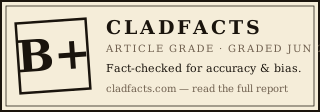
Why this grade: Graded B+: core claims on technologies, benefits, and specific DOT waiver are accurate and corroborated by primary sources; minor deduction for advocacy framing without counter-evidence on regulatory tradeoffs.
Why this lean: Emphasized private-sector innovation, warned of foreign adversaries, and advocated removing 'red tape' while citing industry examples; standard Republican emphasis on deregulation and competitiveness.
Disagree with this grade or political lean?
Tell us why. Your note is reprocessed through the same grading logic; if the output is still off the report is removed, and if it holds up it stays.
Topics in this report
Summary
The clip shows Sen. Todd Young (R-IN) delivering opening remarks at a June 9, 2026, Senate Commerce Subcommittee hearing titled 'The Need for Speed: How Technological Advances are Driving Transportation Innovation.' He highlights autonomous vehicles, train inspection portals, and V2X technologies, their safety and efficiency benefits, and the need for federal flexibility beyond pilot programs. Young references a recent DOT waiver allowing cab-mounted warning beacons as an alternative to traditional triangles and urges Congress to enable commercialization to maintain U.S. leadership against adversaries. The segment ends with recognition of Ranking Member Peters for his remarks. Sourcing draws on real technologies and a documented FMCSA waiver; no outside experts or graphics are shown in the clip.
Editorial Assessment
The speech accurately describes existing technologies and the October 2025 temporary FMCSA waiver for autonomous trucking beacons. Benefits of AVs, rail portals, and V2X are well-established in DOT and industry materials, though the presentation omits potential safety or privacy tradeoffs of accelerated deployment. Framing prioritizes speed to commercialization and competition with China without balancing views on existing rules' rationale. Viewers miss discussion of specific legislative proposals or testimony from the panel on implementation challenges. Overall, it functions as standard congressional advocacy rather than a balanced news segment.
Key Moments
DOT issued a recent waiver allowing cab-mounted warning beacons instead of roadside triangles for certain trucks.
FMCSA approved a temporary waiver for Aurora in October 2025; documented in official FMCSA letter and company announcements.
Train inspection portals use AI to analyze moving trains for defects more effectively than manual checks.
Deployed by Norfolk Southern and CSX; confirmed via company reports and Georgia Tech collaboration using machine vision and AI.
V2X technologies can warn drivers of construction or hazards to prevent accidents.
U.S. DOT promotes V2X for safety and mobility; standard descriptions match agency materials on V2V/V2I communications.
Federal rules have mandated technology too early or without flexibility, slowing proven innovations.
Advocacy position; hearing focuses on barriers but does not detail counter-evidence or safety data supporting original rules.
Sources Consulted
- The Need for Speed: How Technological Advances are Driving Transportation Innovation
- Waiver of Warning Device Requirements
- Aurora says DOT has approved its warning device exemption
- Norfolk Southern deploys second Digital Train Inspection Portal
- Vehicle-to-Everything (V2X) Communications
- The Need for Speed: Young Highlights Technological Advancements in American Transportation