Social Media Bans for Minors Face Enforcement Hurdles and Legal Scrutiny
Embed this grade
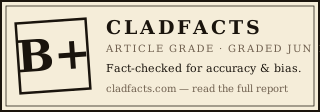
Why this grade: B+: Core claims on Australian enforcement failures, UK proposals, US litigation, and Meta verdicts largely align with recent reporting, though some statistics (e.g., access rates) are approximate and free-speech framing dominates without balanced counter-evidence.
Why this lean: Guest from libertarian-leaning Cato Institute emphasizes government overreach, privacy risks, and parental responsibility while downplaying platform harms; framing consistently skeptical of bans.
Disagree with this grade or political lean?
Tell us why. Your note is reprocessed through the same grading logic; if the output is still off the report is removed, and if it holds up it stays.
Topics in this report
Summary
USA Today interview with Cato Institute senior fellow David Inserra examines global efforts to restrict social media for minors under 16. Segments cover Australia's implemented ban, Britain's proposed measures including curfews and chatbot limits, state-level US actions, Supreme Court signals, recent jury verdicts against Meta, and alternatives like education and parental controls.
The discussion relies on the guest's analysis drawing from policy developments, polling, and court outcomes. It highlights enforcement difficulties, privacy implications, and First Amendment concerns while advocating parental and educational approaches over blanket restrictions.
Editorial Assessment
The segment accurately captures major developments in Australia and the US as of mid-2026, including enforcement shortfalls and ongoing litigation. Framing leans toward skepticism of bans by stressing evasion tactics, unintended consequences, and speech risks while giving limited airtime to potential benefits or platform accountability data. Viewers may miss nuances around varying enforcement outcomes, emerging studies on mental health impacts, or differing state law statuses. Overall factual backbone holds but reflects a consistent anti-regulatory perspective.
Key Moments
60-70% of Australian minors still access social media despite ban
Surveys and reports indicate over 60% retention or continued access via workarounds six months post-implementation.
UK proposing under-16 ban with additional under-18 restrictions and curfews
Recent government announcements outline plans for under-16 bans on major platforms plus feature limits.
Juries in CA and NM found Meta liable for addictive platform design
2026 verdicts held Meta (and YouTube in CA) negligent or liable for harms tied to addictive features and child safety.
Supreme Court case on porn age verification (Paxton) does not extend to broad social media bans
Ruling narrowly upheld age verification for obscene-to-minors content; social media cases face separate 1st Amendment challenges.
Notable Concerns
- Reliance on single expert source with libertarian viewpoint; limited discussion of countervailing research on ban benefits.