Gosar Questions Highlight Salt Cedar Impacts on Arizona Wildfires and Water
Embed this grade
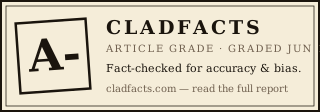
Why this grade: Claims on salt cedar invasiveness, water use, and fire behavior are well-supported by USGS, Forest Service, and scientific sources; fire acreage and 4FRI coordination details align with official records, with only minor naming variances.
Why this lean: Focuses on practical federal-state coordination and invasive removal benefits, aligning with Republican-led emphasis on active forest management without partisan attacks.
Disagree with this grade or political lean?
Tell us why. Your note is reprocessed through the same grading logic; if the output is still off the report is removed, and if it holds up it stays.
Topics in this report
Summary
The segment features Rep. Paul Gosar questioning Forest Service officials during a congressional hearing on recent Arizona wildfires and forest health. Gosar highlights salt cedar as a key invasive species driving water loss and intense fires, asks about restoration benefits, interagency coordination on checkerboard lands, insurance implications, and status of his LASSO Act request.
The exchange includes affirmative responses from Chief Assuault on treatment efficacy and ongoing collaborations like the Four Forest Restoration Initiative. Sourcing draws from named agency officials and references specific 2025-2026 fires; no graphics or additional guests appear in the clip.
Editorial Assessment
The presentation accurately conveys established science on tamarisk's ecological effects and matches documented fire events and restoration programs. Viewers receive solid context on watershed and fuel reduction gains from removal efforts. Minor gaps include lack of discussion on control challenges like biocontrol efficacy or full cost-benefit tradeoffs, and the hearing format limits counter-perspectives. Overall framing supports evidence-based management without distortion.
Key Moments
Salt cedars are the most invasive species in the Southwest, consuming large water amounts, crowding natives, and creating intense wildfire hazards while regenerating aggressively post-fire.
Supported by USGS, USFS FEIS, and multiple studies documenting high water use (up to 200 gal/day), flammability, and post-fire dominance.
Recent fires including Jones, Hazen, Dragon Bravo, and White Sage consumed over 200,000 acres with damage to Grand Canyon North Rim and Kaibab NF.
Kaibab fires alone ~205,500 acres in 2025 per USFS; Jones and Hazen fires occurred near Wickenburg/Buckeye in 2026.
Removing salt cedar increases water yields and improves watershed health via better infiltration and grass utilization.
Agency official and scientific sources confirm reduced evapotranspiration and restored hydrology post-treatment.
Four Forest Restoration Initiative coordinates fuels treatments across national forests with state and private lands in Arizona.
4FRI explicitly covers Kaibab, Coconino and partners on restoration and hazardous fuels reduction.
Sources Consulted
- What is tamarisk? | U.S. Geological Survey
- Saltcedar | Center for Invasive Species Research - UC Riverside
- Kaibab National Forest | White Sage and Dragon Bravo fires
- Southwestern Region | Four Forest Restoration Initiative
- H.R.34 - 119th Congress (2025-2026): LASSO Act
- Impacts of Tamarisk | RiversEdge West