Pollan and Hayes explore consciousness, plants, and AI in philosophical interview
Embed this grade
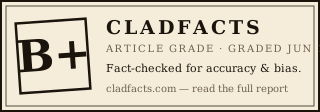
Why this grade: Graded B+: claims about specific plant experiments and declarations are grounded in published research though presented without noting ongoing scientific controversy; AI critique reflects legitimate philosophical debates but relies on selective framing
Why this lean: Mild left lean from emphasis on Silicon Valley as undemocratic concentration of power by 'six white men' and skepticism toward computational functionalism favored in tech circles
Disagree with this grade or political lean?
Tell us why. Your note is reprocessed through the same grading logic; if the output is still off the report is removed, and if it holds up it stays.
Topics in this report
Summary
The segment is an extended interview between host Chris Hayes and author Michael Pollan discussing Pollan's 2026 book A World Appears on consciousness. Topics include continuity from Pollan's prior work on food and psychedelics, plant sentience and neurobiology experiments, the hard problem of consciousness, evolutionary and embodied theories versus computational functionalism, and implications for AI, ethics, and human self-understanding. Pollan draws on interviews with researchers like Stefano Mancuso; Hayes references David Chalmers and Anil Seth. The conversation frames consciousness as potentially extending to plants and animals while questioning whether silicon-based AI can achieve it without embodiment or biological drives.
Editorial Assessment
The broadcast accurately conveys Pollan's arguments and cites real experiments on plant habituation, memory, and anesthetic responses, though it presents controversial 'plant neurobiology' ideas with limited counter-perspectives from mainstream botany. The AI discussion highlights embodied consciousness critiques supported by neuroscientists but underplays functionalist counterarguments prevalent in philosophy and AI research. Viewer misses deeper context on the scientific consensus regarding plant consciousness and the diversity of theories on machine consciousness. Framing is thoughtful and exploratory rather than dogmatic, with mild political commentary on tech industry concentration.
Key Moments
Plants can learn, remember for a month, respond to caterpillar sounds, and are affected by human anesthetics like xenon
Supported by studies on Mimosa pudica habituation (Gagliano 2014) and anesthetic papers by Baluška/Mancuso (NYT coverage 2018)
Cambridge Declaration on Consciousness affirmed animal consciousness in 2012 and expanded further by 2022
2012 declaration exists; 10th anniversary references in 2022 note ongoing expansions to vertebrates and some invertebrates
Consciousness requires embodiment and feelings; computational functionalism is a faulty metaphor for AI
Reflects views of embodied theorists like Seth but omits counterarguments from functionalists and computationalists
Notable Concerns
- Limited acknowledgment of scientific debate over plant sentience claims
Sources Consulted
- A World Appears by Michael Pollan: 9781984881991
- A World Appears - Michael Pollan
- Announcing my new book, A World Appears - Michael Pollan
- Book Review: 'A World Appears,' by Michael Pollan
- A World Appears by Michael Pollan review – a kaleidoscopic exploration of consciousness
- Michael Pollan says AI may 'think' — but it will never be conscious
- Why Is This Happening? The Chris Hayes Podcast - The AI End Game: Is AI Alive? with Michael Pollan
- The Cambridge Declaration on Consciousness
- 10th Anniversary of the Cambridge Declaration on Consciousness
- Stefano Mancuso: The roots of plant intelligence
- The Intelligent Plant