C-SPAN Airs Senate HELP Testimony on AI Risks and Safeguards in K-12 Education
Embed this grade
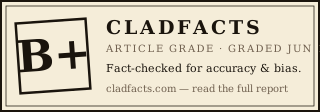
Why this grade: Mostly accurate claims backed by recent studies and reports, including Wharton research on cognitive surrender and district tool proliferation; minor issues with exact usage percentages lacking primary sourcing and one overstated effectiveness multiplier.
Why this lean: Neutral C-SPAN presentation of balanced expert testimony emphasizing both innovation and safety without partisan framing or selective sourcing.
Disagree with this grade or political lean?
Tell us why. Your note is reprocessed through the same grading logic; if the output is still off the report is removed, and if it holds up it stays.
Topics in this report
Summary
The segment covers Erin Mote's testimony before the Senate HELP Subcommittee on AI in K-12 classrooms. Mote, CEO of InnovateEDU, discusses high AI adoption rates, risks of consumer-grade tools leading to cognitive surrender, lack of teacher training, and calls for evidence-based procurement and a waterfall regulatory approach.
Editorial Assessment
Testimony draws on verifiable research such as the 2026 Wharton paper and edtech tool audits, lending credibility to core warnings about over-reliance and the need for purpose-built tools. Viewers miss broader counter-data on AI's documented benefits in personalized learning and specific citations for the 85/84% usage figures. Framing prioritizes caution over rapid adoption without dismissing innovation. The 6-8x reading effectiveness claim exceeds typical meta-analysis findings of moderate advantages for print. Overall presentation is factual and policy-oriented rather than alarmist.
Key Moments
85% of teachers and 84% of students already using generative AI
Approximate figures appear in multiple 2025-2026 surveys; exact match not confirmed in primary data releases
Wharton researchers document cognitive surrender where users accept AI errors ~80% of the time
Matches 2026 Shaw/Nave paper findings from experiments with 1,372 participants
Average school district accesses nearly 3,000 digital tools a year
Consistent with 2026 GoGuardian and EdTech Digest reports on district tool management
Screen-based reading is six to eight times less effective for comprehension than physical books
Meta-analyses show moderate print advantages, not quantified at 6-8x
Notable Concerns
- Some statistics presented without immediate primary sources or full context on sample/methodology
Sources Consulted
- The Future of K-12 Education in the Age of Artificial Intelligence
- Senate Panel Examines AI in K-12 Education
- "From Chalkboards to Chatbots: The Impact of AI on K-12 Education"
- Opportunities, Challenges, and Policy Considerations
- Thinking—Fast, Slow, and Artificial: How AI is Reshaping Human Reasoning and the Rise of Cognitive Surrender
- How AI Is Reshaping Human Intuition and Reasoning
- Rising Use of AI in Schools Comes With Big Downsides for Students
- Time to Rebuild Your Digital Toolkit? K-12 School Leaders Are Focusing on Purpose, Not Products
- Reading print improves comprehension far more than looking at digital text, say researchers
- Erin Mote
- Senate HELP Panel Opens K-12 AI Education Hearing
- 25 AI in Education Statistics to Guide Your Learning